
Origin Investment Corp I Ordinary Shares - ROE
ORIQ
Price:
$10.41
Market Cap:
$89.79M
Origin Investment Corp I is a Special Purpose Acquisition Company (SPAC), established in 2024 under Cayman Islands jurisdiction, and headquartered in Singapore. Its core mission is to achieve a merger or acquisition with one or more enterprises. The company primarily seeks out potential targets within diverse sectors such as financial services, technology, life sciences (biotechnology and pharmaceuticals), high-performance materials, and renewable energy, with a particular strategic focus on businesses operating in Asia.
Industry
Shell Companies
IPO Date
2025-07-02
Stock Exchange
NASDAQ
Ticker
ORIQ
PE Ratio
[61.24]
ROE
[10.66%]
Current Ratio
[5.33]
Dividend Yield
[0%]
Enterprise Value
[89.10M]
Dividend History
The ROE as of September 2026 (TTM) for Origin Investment Corp I Ordinary Shares (ORIQ) is 10.66%
According to Origin Investment Corp I Ordinary Shares’s latest financial reports and current stock price. The company's current ROE is 10.66%. This represents a change of -67.92% compared to the average of 33.21% of the last 4 quarters.
Origin Investment Corp I Ordinary Shares (ORIQ) Historical ROE (quarterly & annually)
How has ORIQ ROE performed in the past?
The mean historical ROE of Origin Investment Corp I Ordinary Shares over the last ten years is 13.16%. The current 10.66% ROE has changed -19.02% with respect to the historical average. Over the past ten years (40 quarters), ORIQ's ROE was at its highest in in the June 2025 quarter at 111.76%. The ROE was at its lowest in in the September 2024 quarter at 0%.
Average
13.16%
Median
13.16%
Minimum
-36.64%
Maximum
62.96%
Origin Investment Corp I Ordinary Shares (ORIQ) ROE by Quarter and Year
Discovering the peaks and valleys of Origin Investment Corp I Ordinary Shares ROE, unveiling quarterly and yearly fluctuations to gain insights into the company’s financial performance and market dynamics, offering valuable data for investors and analysts alike.
Maximum Annual Increase = 0%
Maximum Annual ROE = 62.96%
Minimum Annual Increase = -271.82%
Minimum Annual ROE = -36.64%
| Year | ROE | Change |
|---|---|---|
| 2025 | 62.96% | -271.82% |
Origin Investment Corp I Ordinary Shares (ORIQ) Average ROE
How has ORIQ ROE performed in the past?
The current ROE of Origin Investment Corp I Ordinary Shares (ORIQ) is less than than its 3-year, less than than its 5-year, and less than than its 10-year historical averages
3-year avg
13.16%
5-year avg
13.16%
10-year avg
13.16%
Origin Investment Corp I Ordinary Shares (ORIQ) ROE vs. Peers
How is ORIQ’s ROE compared to its peers?
Origin Investment Corp I Ordinary Shares’s ROE is less than A SPAC III Acquisition Corp. (95.79%), less than byNordic Acquisition Corporation (13.63%), less than UY Scuti Acquisition Corp. (2.14%), less than Cayson Acquisition Corp Ordinary shares (2.60%), less than Lakeshore Acquisition III Corp. (3.75%), greater than Maywood Acquisition Corp. Unit (-0.29%), less than Columbus Acquisition Corp (7.65%), less than Columbus Acquisition Corp (7.65%), less than Quantumsphere Acquisition Corp. Units (2.62%),
| Company | ROE | Market cap |
|---|---|---|
| 95.79% | $25.41M | |
| 13.63% | $92.22M | |
| 2.14% | $84.24M | |
| 2.60% | $59.86M | |
| 3.75% | $94.57M | |
| -0.29% | $85.11M | |
| 7.65% | $86.46M | |
| 7.65% | $47.87M | |
| 2.62% | $88.32M |
Build a custom stock screener for Origin Investment Corp I Ordinary Shares (ORIQ) and other stocks
One of the best ways to find valuable stocks to invest in is to build a custom made screener in your Excel or Google Sheets spreadsheet. This allows you to compare thousands of companies like Origin Investment Corp I Ordinary Shares using the financials and key metrics that matter to you in a single view.
The easiest way to set this up is to use the Wisesheets add-on and set your spreadsheet like this:
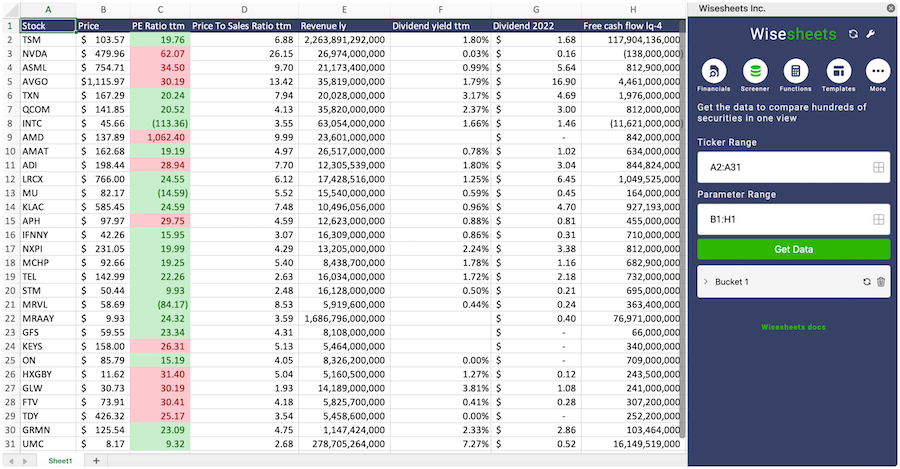
Covering all these metrics from financial, data, dividend data, key metrics and more you can get all the data you want for over 50+ exchanges worldwide.
Get your free trial here.
Origin Investment Corp I Ordinary Shares (ORIQ) and other stocks custom spreadsheet templates
The easiest way to analyze a company like Origin Investment Corp I Ordinary Shares or any others is to create a spreadsheet model that automatically retrieves all of the stock data you need.
Using Wisesheets you can set up a spreadsheet model like this with simple spreadsheet formulas. If you change the ticker you can get all of the data automatically updated for you.
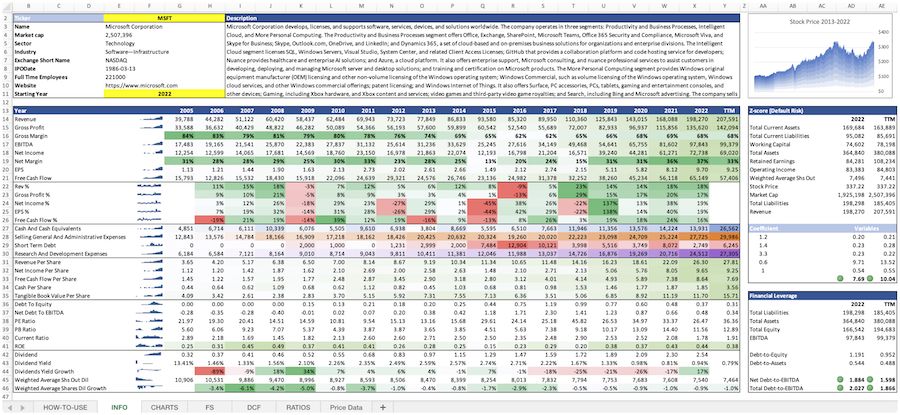
Whether you need live data, historical price data, financials, dividend data, key metrics, analyst estimates, or anything else...Wisesheets has you covered.
Frequently asked questions❓
What is the ROE?
How can you use the ROE?
What is Origin Investment Corp I Ordinary Shares's ROE?
How is the ROE calculated for Origin Investment Corp I Ordinary Shares (ORIQ)?
What is the highest ROE for Origin Investment Corp I Ordinary Shares (ORIQ)?
What is the 3-year average ROE for Origin Investment Corp I Ordinary Shares (ORIQ)?
What is the 5-year average ROE for Origin Investment Corp I Ordinary Shares (ORIQ)?
How does the current ROE for Origin Investment Corp I Ordinary Shares (ORIQ) compare to its historical average?