VFIAX vs VOO: Which Should You Buy?
Same fund company (Vanguard), same 0.04% fee, about 100% the same holdings.
For most investors it barely matters. VFIAX and VOO have returned effectively the same amount per year and overlap about 100% by weight. Pick VFIAX for the tighter 504-holding portfolio; pick VOO to own 505 instead. Both cost 0.04% per year.
This is purely for informational purposes, not investment advice. Always consult a professional before making investment decisions.
VFIAX wins if...
You want the tighter portfolio: 504 holdings rather than 505, tracking the Vanguard 500 Index.
VOO wins if...
You want maximum diversification: 505 holdings covering the broader market, tracking the Standard & Poor's 500 Index.
VFIAX vs VOO, side by side
The numbers that actually differ are highlighted.
| Metric | VFIAXVanguard 500 Index Fund Admiral Shares | VOOVanguard S&P 500 ETF |
|---|---|---|
| Index tracked | Vanguard 500 Index | Standard & Poor's 500 Index |
| Number of holdings | 504 | 505 |
| Expense ratio | 0.04% | 0.03% |
| Dividend yield | 1.04% | 1.05% |
| AUM | $1.80T | $1.80T |
| Top 10 concentration | 37.8% | 37.8% |
| 10-yr total return | 15.4% | 15.4% |
| 5-yr total return | 13.5% | 13.5% |
| Beta (vs S&P 500) | 1.01 | 1.01 |
| Max drawdown (10yr) | -33.8% | -34.0% |
| Market-cap coverage | Large cap | Large cap |
| Inception | 2000 | 2010 |
VFIAX holds 504 positions tracking the Vanguard 500 Index. VOO holds 505, a broader slice of the same market.
How much do VFIAX and VOO overlap?
The single most decision-relevant fact, and the one most comparisons skip.
- Shared
- 100.0%
- VOO-only
- 0.0%
~100% identical by weight
503 weighted positions appear in both funds, and by weight about 100% of the two portfolios is the same exposure. Where a stock sits in both, the shared share is whichever weight is smaller. That is the part of a dollar that behaves identically in either fund.
The difference is VOO's remaining 1 positions, which VFIAX does not hold at all. They are smaller by weight, which is why the two track each other closely and drift apart only at the margins.
Growth of $10,000: VFIAX vs VOO
Growth of $10,000
10 years
Which should you choose?
- You want concentrated exposure: 504 holdings, not 505
- You want to track the Vanguard 500 Index
- You want the wider net: 505 holdings against 504
- You want to track the Standard & Poor's 500 Index
- You want the higher yield: 1.05% against 1.04%
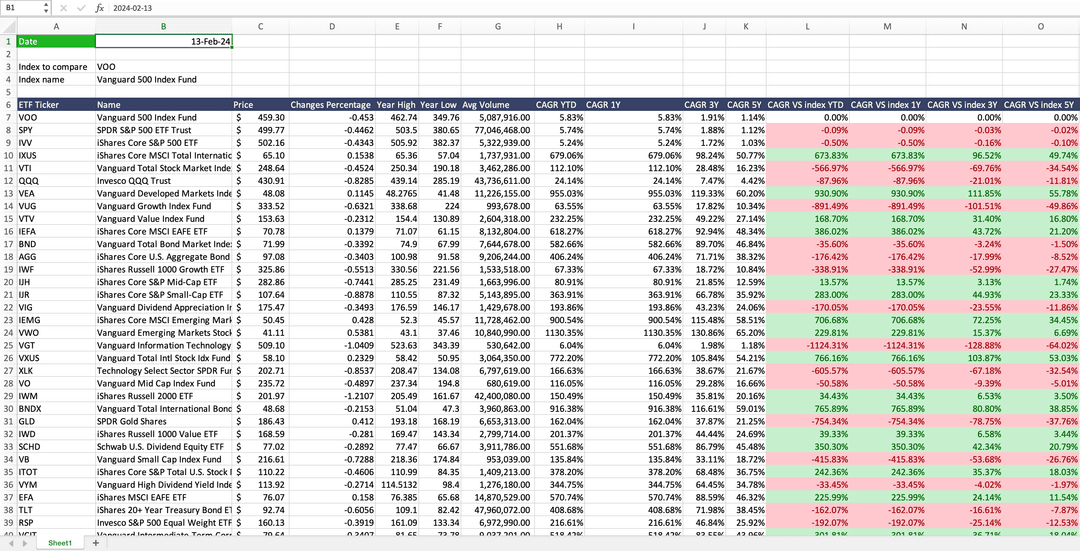
Compare and track all ETFs in your sheet
Type =WISE("VFIAX","dividend yield","ttm") or =WISEFUNDS("VFIAX","expense ratio") in Excel or Google Sheets and the fund's data lands in your sheet, ready to be refreshed when you want.
Get The Add-in - FreeVFIAX vs VOO frequently asked questions
For most investors the choice barely matters: VFIAX and VOO have returned effectively the same amount per year and they overlap roughly 100% by weight. Both charge 0.04%, so cost is not the deciding factor.
VFIAX holds 504 positions tracking the Vanguard 500 Index. VOO holds 505, a broader slice of the same market.
Yes, by about 100% by weight. 503 weighted positions appear in both funds. Because the largest positions dominate both portfolios, the two behave similarly day to day.
You can, but there is little reason to. At about 100% overlap, owning both mostly duplicates the same positions and adds little diversification.